

Travel advice · Dayworthy
How to pick (and survive) your trip itinerary
A few things we’ve learned about planning trips that go smoothly, even when the weather, the trains or your own curiosity have other plans.
Keep readingPublished:
Before we start
A good plan bends without breaking.
Here at Dayworthy we love a good plan. We also know that almost no trip goes exactly the way the plan says it will. It rains. A train runs late. You take a wrong turn, find a little shop you never want to leave, and suddenly it’s four in the afternoon.
None of that is a failure. That’s just what traveling is like. The trick is to build a plan that can handle it. These are the things we recommend, more or less in the order they come up when you’re putting a trip together.
Tip 1 · Your must-dos
Pick your non-negotiables first.
Here at Dayworthy we suggest starting with a short list of the things you absolutely want to do. Not everything that looks nice, just the handful you’d really be disappointed to miss.
Then scatter them across your visit instead of piling them onto one day. Put a couple of your non-negotiables into each day, and fill the rest of the time with secondary things that would be great to see but wouldn’t ruin the trip if you skipped them.
That way, when a day goes sideways, you already know what to drop. You cut the maybes, keep the must-dos, and still go to bed knowing you did the things that mattered. Nobody wants to end a day frustrated because they didn’t get through a list of twelve.
Choose one or two per day
Your non-negotiables, in the area you’ll actually be that day.
Add a few maybes
Things nearby that are flexible and easy to drop.
Protect the must-dos
If time gets tight, the maybes go first, every time.

Tip 2 · Reservations
Be picky about what you reserve.
Some things really do need a reservation made ahead of time: a famous museum, a popular tour, a table somewhere special. Here at Dayworthy we think those are worth it, for the right things.
Just keep in mind what a reservation does to your freedom. It locks you into a time. You might be having a wonderful time somewhere else and have to cut it short, or eat before you’re hungry, or skip something altogether because you’re running late.
So we recommend reserving only the things that are truly critical, and spreading them out across your trip instead of clustering them. A day with one reservation is easy to build around. A day with four starts to feel like a train timetable.

Tip 3 · Getting there
Match your arrival to check-in.
When you’re choosing flights, trains or buses to your next stop, think about when you’ll actually arrive and how that lines up with check-in. It’s tempting to get there as early as possible so you can squeeze in more of the city. But dragging a suitcase around a place you don’t know yet isn’t fun, and it’s not the best way to meet a new city.
This matters even more with vacation rentals and similar stays, where there’s often no front desk to hold your bags. If you can, plan your arrival around check-in time. If you can’t, look for a luggage locker near the station, or ask your host or hotel whether they’ll keep your bags until your room is ready.
The same goes for the way out. A late check-out, or a bag drop at the front desk, can give you one more relaxed morning.

Tip 4 · Where to stay
Choose your lodging by location first.
We highly suggest picking where you stay by location before anything else. We’ve stayed in lovely rooms that we didn’t enjoy much because the area felt sketchy, was too far from food and transport, or just wasn’t somewhere we wanted to be after dark. And we’ve stayed in modest rooms in exactly the right spot that made the whole trip better.
What “right” means is up to you, but here are the kinds of things a good location can give you:
Easy transport
A station or stop nearby, so getting around takes less effort.
Food and drink close by
Restaurants, cafés and bars you can walk to, so you can try more of the place.
A street that feels good at night
Somewhere you’re happy to walk home through.
A view that makes you smile
Sometimes the best feature of a place is just the window.

Tip 5 · Timing
Book your lodging early.
Which brings us to timing. We recommend booking your accommodation as soon as you reasonably can. The choice you have six months out can look very different from the choice you have two months out.
It can feel like the same place at the same price whenever you book. But the well-located, well-loved places tend to go first, so by the time you look later you’re often choosing from whatever other travelers left behind. If you can, pick an option that lets you change your plans, so you get the early choice without the worry.
Tip 6 · Days that make sense
Group each day by neighborhood.
Two places that look close together on a map can take an hour to connect. Here at Dayworthy we like to build each day around one area, so you spend your time exploring instead of commuting across town. It also makes it much easier to swap things around when plans change.
Tip 7 · Breathing room
Leave room to wander, and keep a rainy-day list.
Leave at least one stretch of your trip with nothing planned. Often it’s the unplanned afternoon, the café you walked into by accident, that you end up telling people about. Think of free time as a non-negotiable, too.
And keep a short list of indoor ideas for when the weather turns. A rainy day is a lot less annoying when you already know where you’re headed.

Tip 8 · Little checks
Check opening days before you commit.
Many museums and attractions close one day a week, and some close for renovations or holidays. A quick check while you’re deciding which day is for what can save you a long walk to a locked door.
Tip 9 · Be ready
Keep the essentials where you can reach them.
Save your reservations, addresses and confirmation numbers somewhere you can open without a signal: screenshots, a printed page, or a note on your phone. A dead battery or a patchy connection is much easier to handle when everything you need is already in your pocket.
A little help
Having trouble keeping your plans organized? We can help!
We built the Dayworthy web app for exactly this: one place to collect your ideas, turn them into realistic days, and keep your must-dos safe while everything else stays flexible.
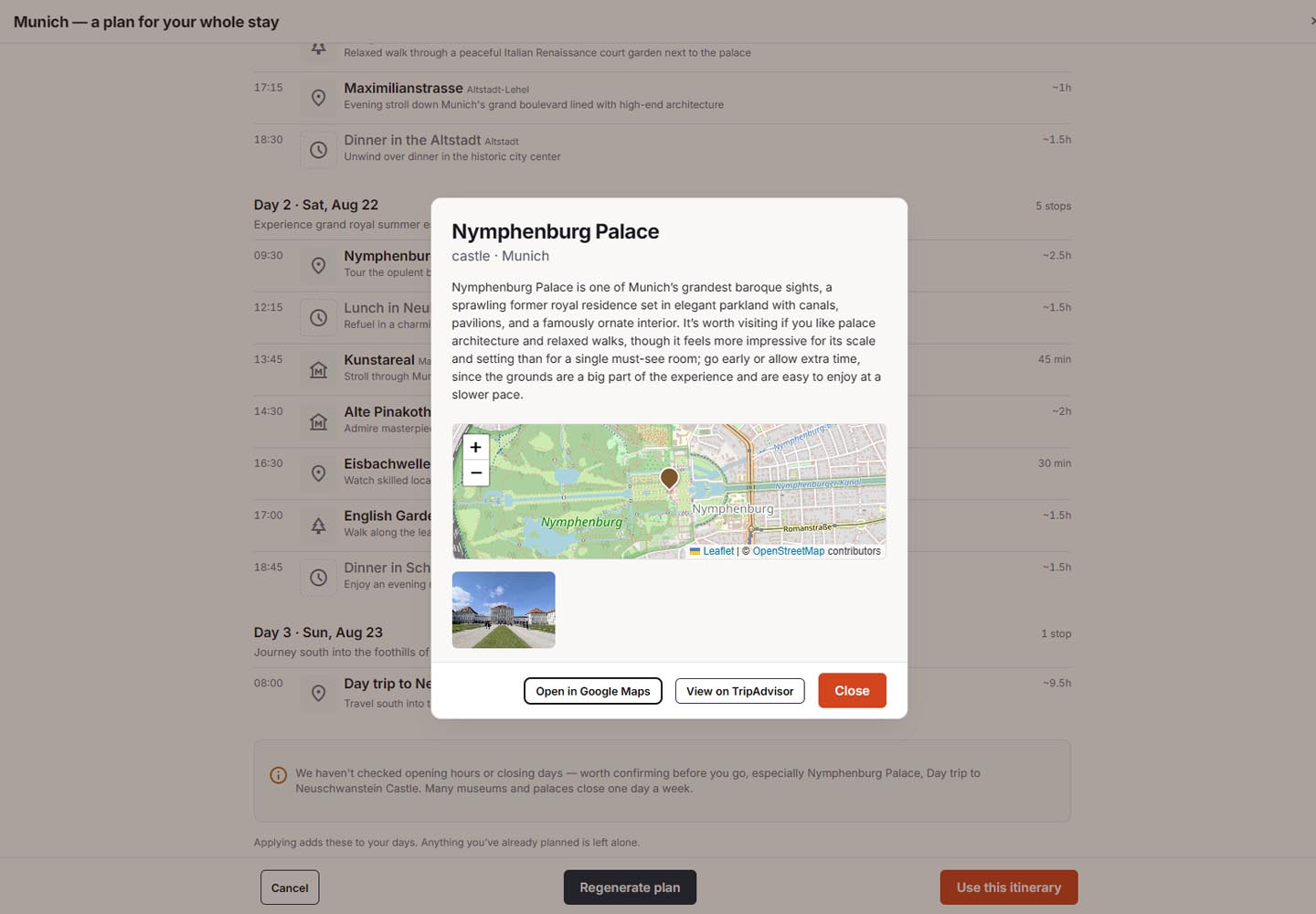
A realistic plan for your whole stay
Tell us where you’re going and how long you have, and Dayworthy builds days that make sense, with your must-dos separated from the nice-to-haves.
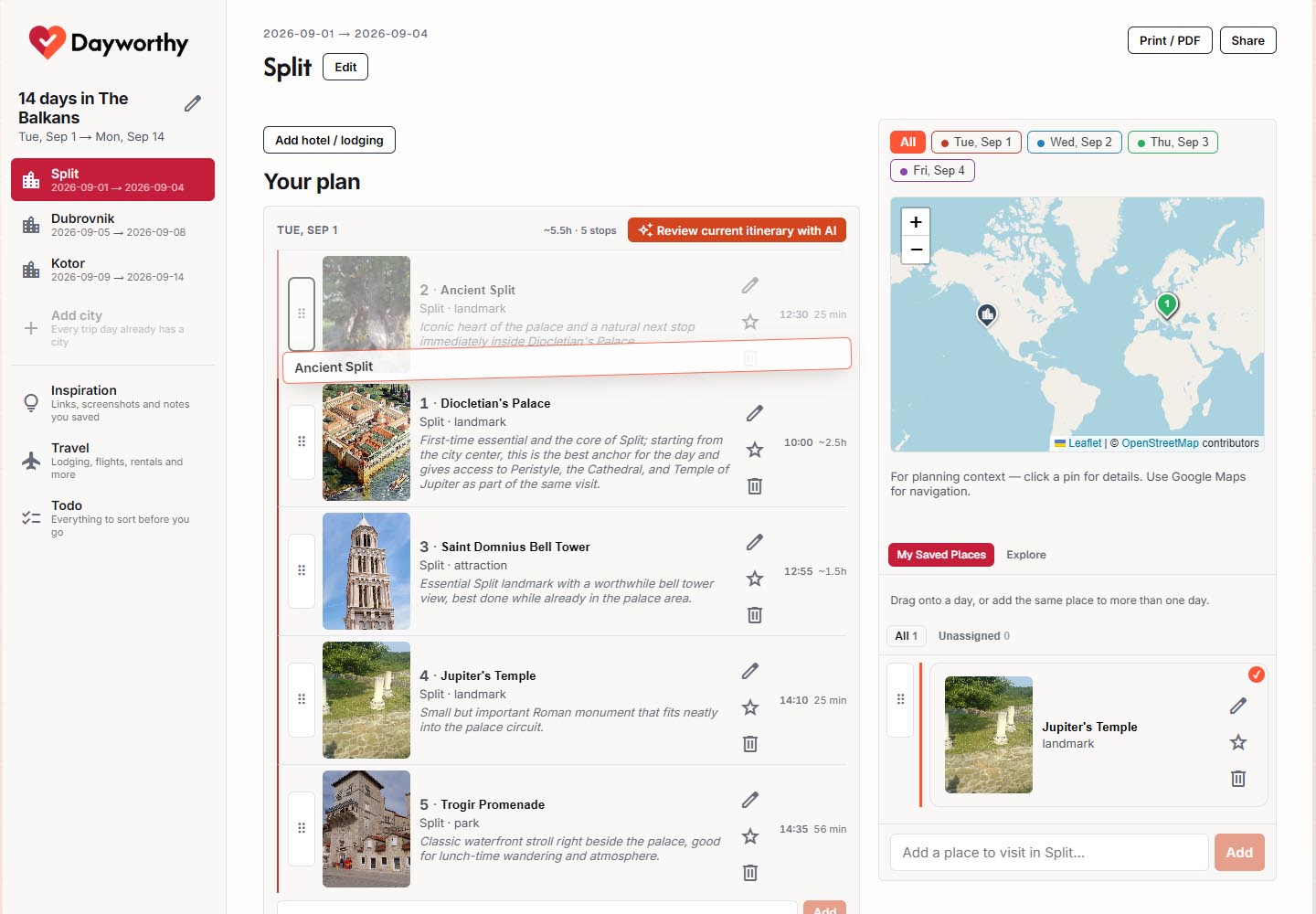
Shuffle things when the day goes sideways
Reorder stops, move ideas between days and park optional places for later, without losing the things you really can’t miss.
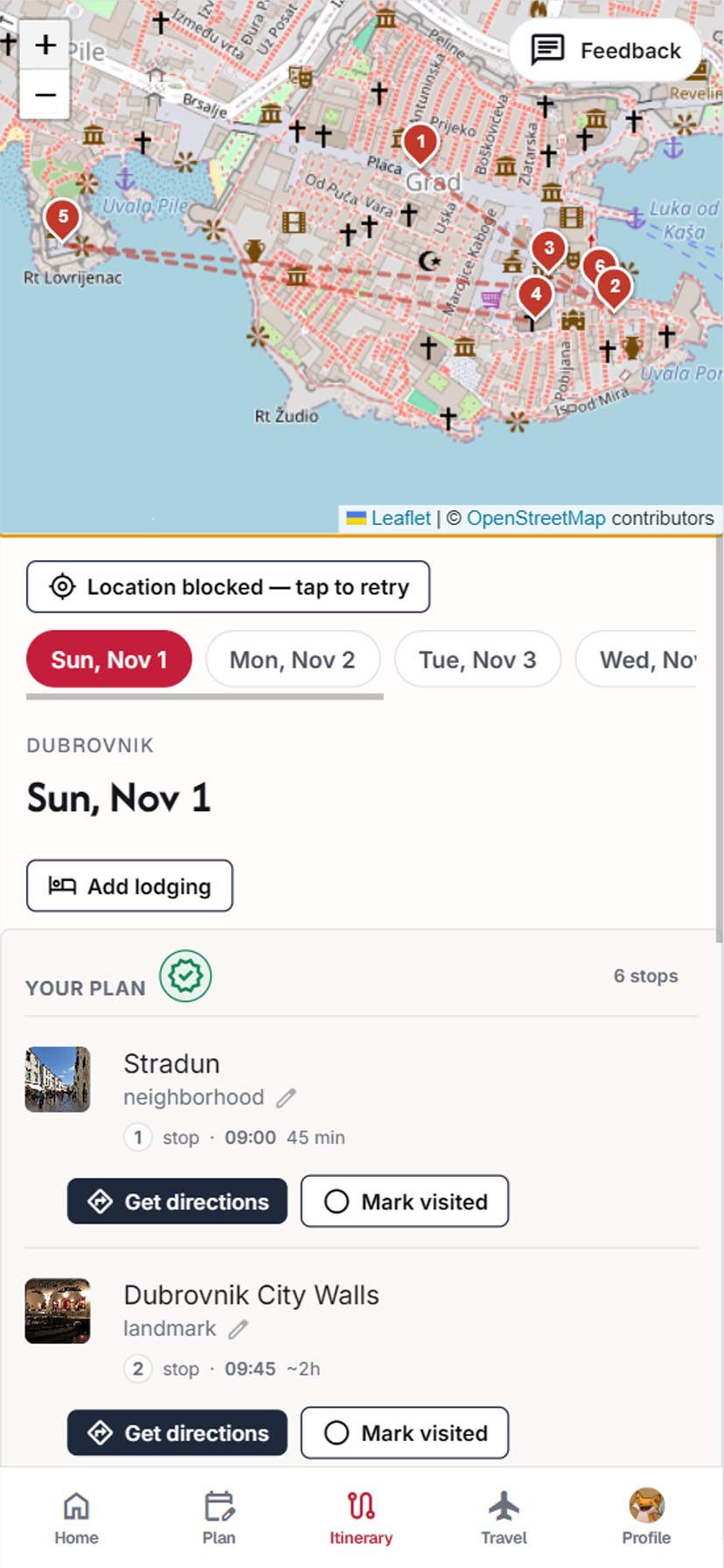
Know what’s next, right when you need it
Travel-day mode shows today’s plan and your next stop, so you’re not digging through notes and browser tabs.
Free to start. No card needed.